


EMDR therapy follows 8 structured phases that move from assessment through reprocessing to reevaluation. The phases are sequential, and a trained clinician does not skip forward. Understanding the sequence explains why the first several sessions involve no reprocessing at all.
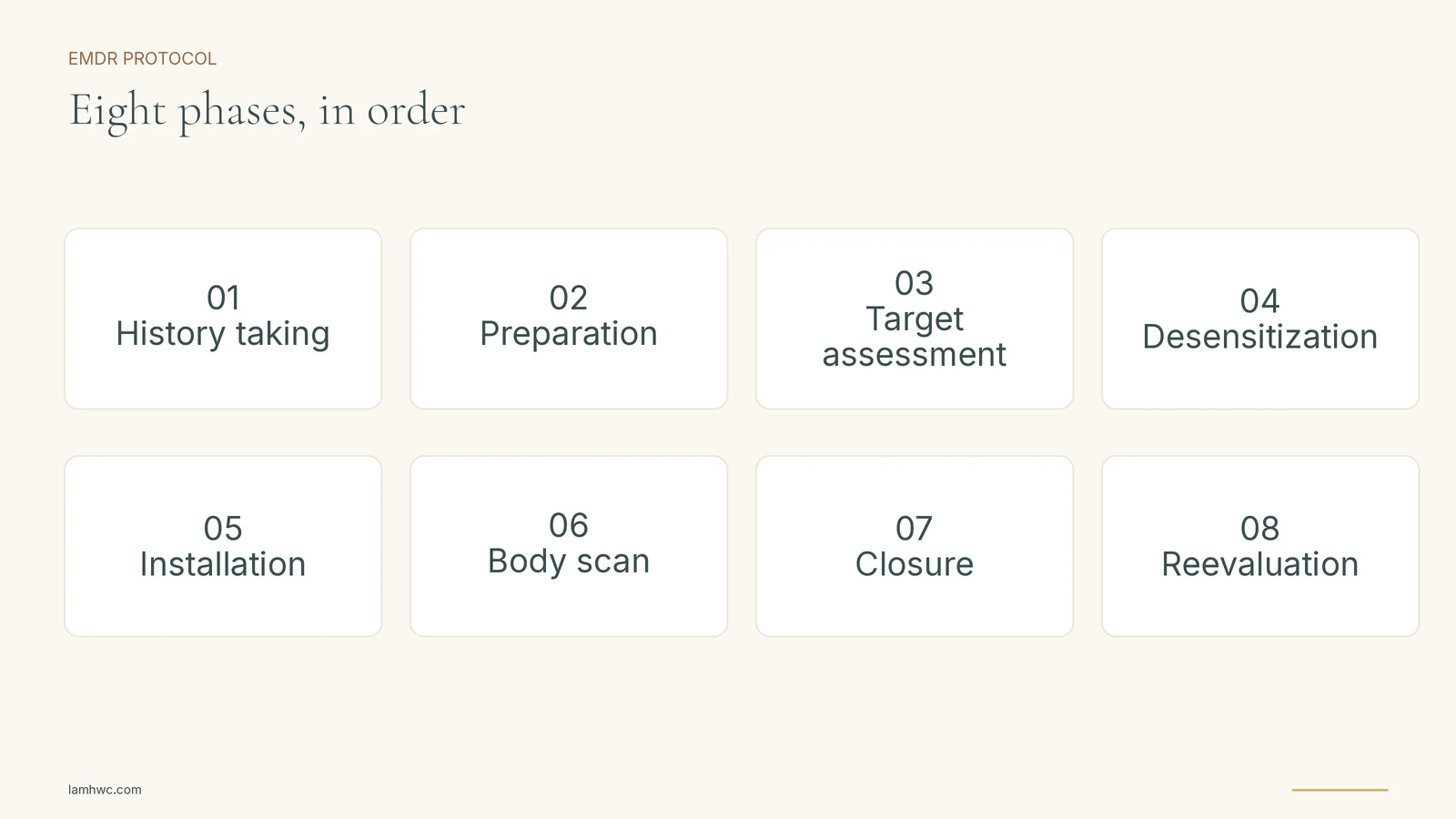
Phase 1: History Taking and Treatment Planning
The clinician gathers history and identifies which memories will be targeted. This phase establishes a timeline of significant events, current symptoms, and the specific triggers that maintain distress today. Target selection happens here, not later.
Phase 2: Preparation and Stabilization
Preparation builds the coping skills a client needs before reprocessing begins. Four tools are taught in this phase.
- Calm place or safe place visualization.
- Grounding techniques for use between sessions.
- Containment imagery for setting distress aside.
- Breathing and body-based regulation skills.
Clients with complex trauma often spend several sessions here. Skipping stabilization is the most common reason EMDR feels overwhelming rather than productive.
Phase 3: Assessment of the Target Memory
The clinician and client define the specific memory to process. Four elements are established.
- The image that represents the worst part of the memory.
- The negative belief attached to it, such as I am not safe.
- The positive belief the client would prefer to hold.
- Baseline ratings of distress and belief strength.
These baselines make change measurable across later sessions.
Phases 4 Through 6: Desensitization, Installation, and Body Scan
Phases 4 through 6 are the reprocessing core of EMDR.
- Phase 4, desensitization: the client holds the target while following bilateral stimulation, and distress is rated repeatedly until it drops.
- Phase 5, installation: the positive belief is strengthened and linked to the memory.
- Phase 6, body scan: the client scans for residual physical tension connected to the target.
Bilateral stimulation uses eye movements, alternating taps, or alternating tones. What actually happens in the room is described in what happens in an EMDR therapy session.
Phase 7: Closure
Closure returns the client to a regulated state before leaving. The clinician uses containment or calm place imagery and reviews what to expect between sessions. Every session ends with closure, including sessions where processing is incomplete.
Phase 8: Reevaluation
Reevaluation opens the next session by checking whether the previous target held. The clinician rechecks distress ratings, reviews what surfaced during the week, and decides whether to continue the same target or move to the next one.
How the Phases Fit Into a Full Course of Treatment
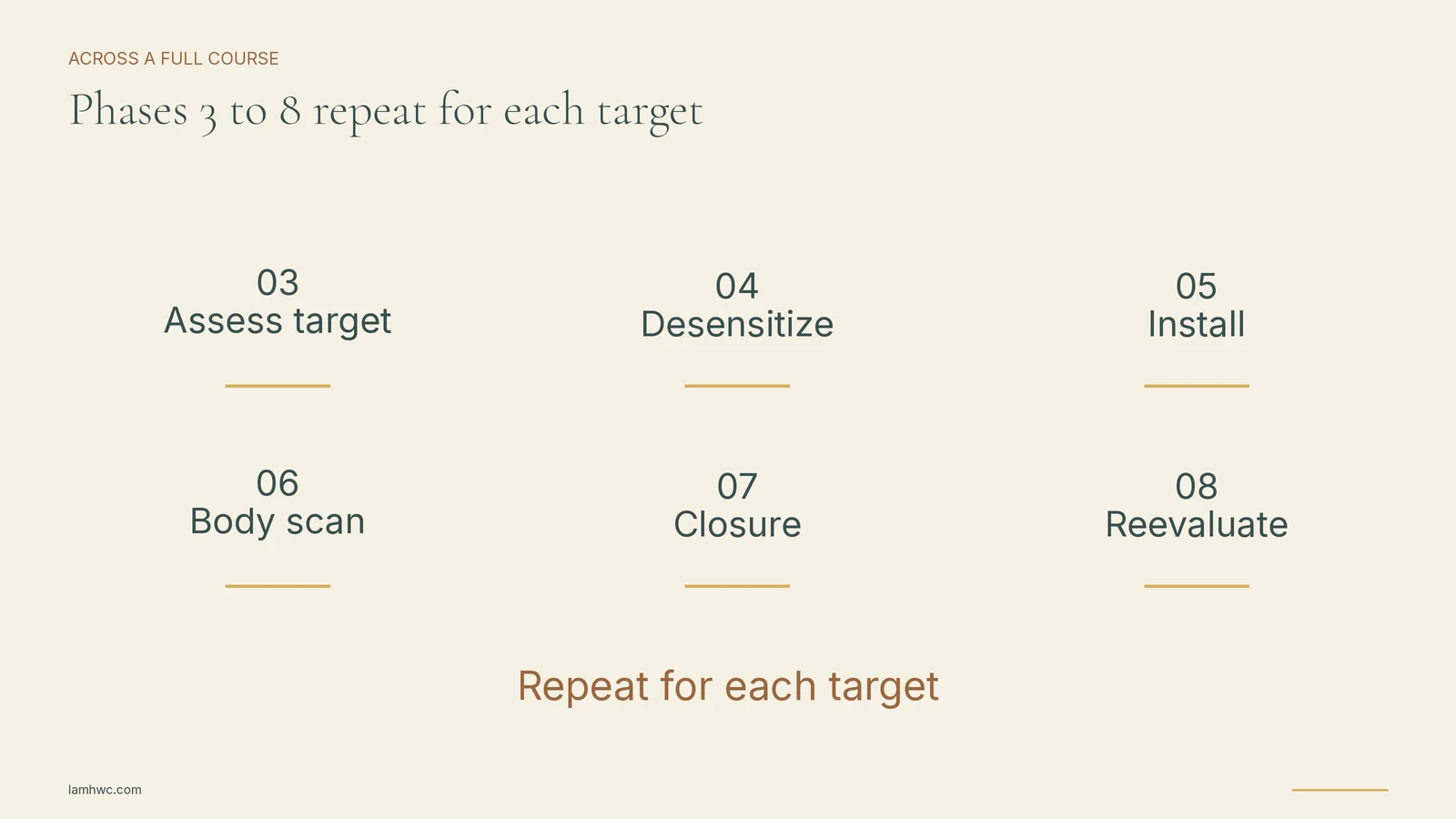
The 8 phases repeat for each target memory rather than running once across treatment. A client with a single incident may complete the cycle in a handful of sessions. A client with repeated developmental trauma cycles through phases 3 through 8 many times.
Duration questions are covered in how long does EMDR therapy take. Broader background on the model, including who it helps, appears in our EMDR therapy guide, and the trauma-specific application is covered in healing trauma with EMDR therapy.
What Should Clients Track Between Sessions?
Between-session tracking supports phase 8 reevaluation. Clinicians commonly ask clients to note 3 things: dreams or images that surface, changes in physical reactivity to known triggers, and any new memories that appear. That log becomes the starting material for the next session rather than an assignment to complete.
Frequently Asked Questions
Do all 8 phases happen in every session?
No. Phases 1 and 2 occur at the start of treatment and may span several sessions. Phases 3 through 8 repeat for each memory target, and phase 7 closes every session regardless of where processing stopped.
How many sessions before reprocessing starts?
Reprocessing typically begins between session 3 and session 5. Clients with complex trauma histories, dissociation, or limited current support often spend longer in preparation, and that extra time improves outcomes rather than delaying them.
Can EMDR phases be done out of order?
No. The sequence is part of the protocol, and reprocessing without adequate preparation raises the risk of destabilization. A clinician may return to earlier phases mid-treatment, which is a normal adjustment rather than a setback.
What happens if a session ends mid-processing?
The clinician uses containment and grounding to close safely, and the target resumes at the next session during reevaluation. Incomplete sessions are expected and are built into the protocol.